
External Wall Insulation: More Than Just Warmth
When most homeowners think about external wall insulation (EWI), they focus on one thing: keeping their homes warmer in winter. And while that’s certainly a major benefit, it’s far from the only advantage this upgrade offers.
External wall insulation transforms your home in ways that go well beyond thermal performance. From creating a quieter living environment to dramatically improving your property’s kerb appeal, EWI delivers multiple benefits that can enhance both your comfort and your home’s value.
Let’s explore what makes external wall insulation such a comprehensive home improvement solution.

The Soundproofing Advantage You Didn’t Know About
One of the most underrated benefits of external wall insulation is its ability to significantly reduce noise pollution. If you live on a busy road, near a school, or in any area with regular external noise, EWI can make a remarkable difference to your quality of life.
That noisy traffic outside? It’ll sound like it’s further away. The neighbour’s lawnmower on Saturday morning? Far less intrusive. Children playing in the street? You’ll still hear them, but they won’t dominate your living space.
The soundproofing effect comes from the additional mass and density that insulation adds to your external walls. Materials like mineral wool and expanded polystyrene (EPS) are particularly effective at absorbing sound waves, creating a buffer between your home and the outside world.
Real-world impact:
- Better sleep quality – especially in bedrooms facing busy streets
- Improved concentration – ideal for home offices or study spaces
- More peaceful living spaces – enjoy your home without constant background noise
- Increased privacy – sound insulation works both ways, keeping your conversations inside
Transforming Your Home’s Appearance
External wall insulation isn’t just functional – it’s an opportunity to completely refresh and modernise your property’s exterior.
A fresh, contemporary look
EWI systems are finished with a protective render that comes in a wide range of colours, textures, and finishes. Whether you prefer a smooth, modern aesthetic or a textured, traditional appearance, there’s an option to suit your taste.
Many homeowners use EWI as a chance to:
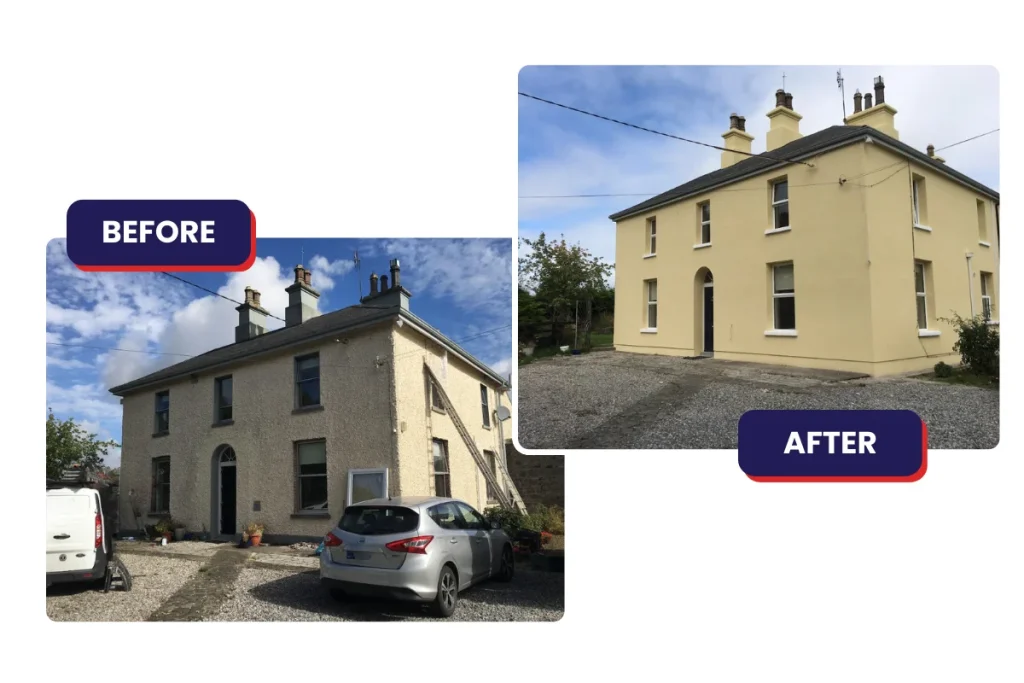
- Update tired, weathered exteriors – cracked render, stained brickwork, or dated pebbledash can all be covered with a fresh, uniform finish
- Modernise older properties – give a period home a contemporary edge whilst maintaining its character
- Create uniformity – if your home has mismatched materials or patchy repairs, EWI provides a consistent, professional appearance
- Increase kerb appeal – a well-finished EWI system can significantly enhance your property’s street presence and market value
What to expect from a completed project
While every home is different, a professional EWI installation typically transforms the exterior appearance completely. The insulation layer evens out any imperfections in the original wall surface, while the render finish provides a clean, weather-resistant coating that looks sharp and modern.
The finished result is a home that not only performs better but looks better too – a win-win for comfort and aesthetics.
Planning Permission: Navigating the Grey Area
This is where things get a bit more complex. Whether you need planning permission for external wall insulation in Ireland depends on several factors, and it’s not always straightforward.
When is planning permission required?
According to the Planning and Development Act 2000, Section 4(1)(h), works that “affect only the interior of the structure or which do not materially affect the external appearance of the structure so as to render the appearance inconsistent with the character of the structure or of neighbouring structures” are typically exempt from planning requirements.
The key phrase here is “materially affect the external appearance”. This is where the grey area emerges.
Factors that influence planning requirements:
- Location and setting – Urban streets with uniform character are more likely to require approval than rural or mixed-character areas
- Change in appearance – If your EWI will significantly alter the look of your home compared to neighbouring properties, planning may be needed
- Protected structures – Any work on a Protected Structure or within an Architectural Conservation Area (ACA) has stricter requirements
- Material change – For example, covering a brick façade with render on a street of brick homes would likely require approval
Protected structures and conservation areas
If your home is a Protected Structure or located in an Architectural Conservation Area, planning requirements are more stringent. Under Section 57(1)(a) & (b) of the Planning Act, work must not “materially affect the character of the structure or any element of the structure which contributes to its special architectural, historical, archaeological, artistic, cultural, scientific, social or technical interest.”
Our strong recommendation: Check first
Planning permission requirements can vary between local authorities, and the consequences of getting it wrong are serious. If you proceed without the required permission, you could face:
- Enforcement notices requiring the removal of the insulation at your own expense
- Retention permission fees (three times the standard planning fee)
- Legal penalties, including fines
Before proceeding with EWI, we recommend:
- Consult your local authority’s planning department – they can advise whether your specific project requires approval
- Work with an experienced contractor – at Leetherm, we’re familiar with planning considerations and can guide you through the process
- Get it in writing – if the council confirms planning isn’t needed, request written confirmation for your records
The time investment in checking beforehand is minimal compared to the potential cost of having to remove completed work.

Maintenance: Keeping Your EWI System in Top Condition
One of the great advantages of external wall insulation is that it’s remarkably low-maintenance. With proper care, a quality EWI system can last 30-60 years or more, protecting your home and delivering energy savings for decades.
Annual maintenance checklist
To keep your EWI system performing at its best:
Visual inspection (twice yearly)
- Check for cracks, chips, or damage to the render finish
- Look for signs of water penetration or damp patches
- Inspect around windows, doors, and other penetrations for gaps or deterioration
- Check that drainage and guttering are functioning properly to prevent water from running down the insulated walls
Cleaning (as needed)
- Remove dirt, algae, or moss growth with a soft brush and mild detergent solution
- Avoid pressure washers, which can damage the render finish
- For stubborn stains, consult your installer about appropriate cleaning products
Minor repairs
- Address small cracks or chips promptly to prevent water ingress
- Use appropriate repair materials recommended by your installer
- Don’t delay repairs – small issues can become bigger problems if left unattended
Professional inspection (every 5-10 years)
- Have a qualified contractor inspect the system for any underlying issues
- Check that all seals, joints, and penetrations remain watertight
- Assess the overall condition and performance of the system
Common issues to watch for:
- Algae or moss growth – particularly on north-facing walls or shaded areas; usually cosmetic but should be cleaned
- Cracks in render – can occur due to building movement or impact damage; should be repaired promptly
- Water staining – may indicate issues with guttering or drainage rather than the EWI system itself
- Render discolouration – normal weathering over time, but excessive staining may require cleaning
Warranty and guarantees
At Leetherm, we work with the highest quality suppliers and materials, all backed by relevant warranties and guarantees. Your EWI system is a long-term investment, and we ensure it’s protected accordingly.
Top maintenance tip: The best maintenance is prevention. Ensure your guttering and downpipes are clear and functioning properly. Most EWI issues stem from water management problems rather than the insulation system itself.
It’s worth noting that many of these maintenance tasks – checking for cracks, cleaning exterior surfaces, ensuring gutters work properly, and inspecting around windows and doors – are things you should be doing with any home exterior, whether it has EWI or not. In fact, a well-installed EWI system often requires less maintenance than traditional rendered walls, older brickwork, or pebbledash, which can be prone to cracking, water penetration, and weather damage. The difference is that with EWI, you’re protecting a valuable investment, so staying on top of basic maintenance makes good financial sense. Think of it as the same care you’d give your car or boiler – a little attention goes a long way in preserving performance and longevity.

Why Choose Leetherm for Your External Wall Insulation?
External wall insulation is a significant investment in your home, and choosing the right contractor makes all the difference.
What sets Leetherm apart:
- SEAI-registered One Stop Shop – access the full range of SEAI grants and supports
- Comprehensive service – from initial assessment through to final inspection and grant administration
- Quality materials – we use only the highest quality insulation systems with full warranties
- Expert guidance – including planning permission advice and local authority liaison
- Integrated approach – EWI works best as part of a whole-home energy upgrade strategy
SEAI grant support
External wall insulation qualifies for SEAI grant support as part of the Home Energy Upgrade scheme. Grant amounts vary depending on your home type and the scope of work, but can significantly reduce the overall cost of your upgrade.
As a registered One Stop Shop, Leetherm handles all the grant paperwork and administration, making the process as straightforward as possible.
Ready to Transform Your Home?
External wall insulation delivers benefits that go far beyond energy savings. A warmer, quieter, better-looking home with lower heating bills and increased value – it’s an investment that pays dividends for decades to come.
If you’re considering external wall insulation for your home, we’re here to help. Our team can assess your property, advise on planning requirements, explain your grant options, and deliver a professional installation that transforms your home inside and out.
Contact Leetherm today to arrange a free, no-obligation assessment and discover how external wall insulation could benefit your home.
